# Leistungsdaten

## Dynamik

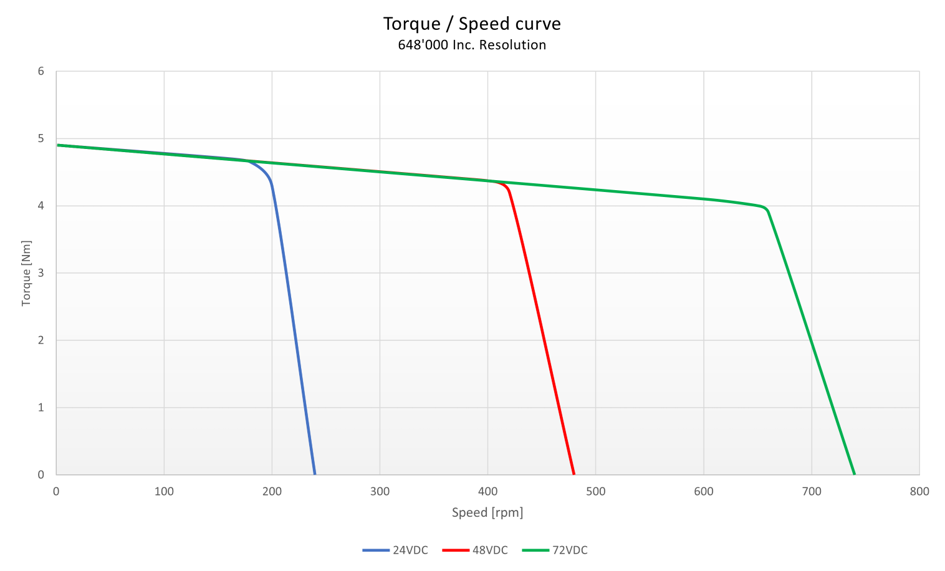
<table><thead><tr><th width="284.22216796875">Speisespannung</th><th></th><th width="112.611083984375"></th><th align="right">24 VDC</th><th align="right">48 VDC</th><th align="right">72 VDC</th></tr></thead><tbody><tr><td>Nenndrehzahl <sup>(1)</sup> 648'000 Ink.</td><td>n<sub>N</sub></td><td>min⁻¹</td><td align="right">180</td><td align="right">420</td><td align="right">650</td></tr><tr><td>Nenndrehzahl <sup>(1)</sup> 2'592'000 Ink.</td><td>n<sub>N</sub></td><td>min⁻¹</td><td align="right">200</td><td align="right">200</td><td align="right">200</td></tr></tbody></table>

<table data-header-hidden><thead><tr><th width="284.22216796875">Speisespannung</th><th width="131.4444580078125"></th><th width="112.611083984375"></th><th align="right"></th></tr></thead><tbody><tr><td>Anhaltemoment</td><td>M<sub>0</sub></td><td>Nm</td><td align="right">4.2</td></tr><tr><td>Nenndrehmoment <sup>(1)</sup></td><td>M<sub>N</sub></td><td>Nm</td><td align="right">4.0</td></tr><tr><td>Max. Drehmoment <sup>(2)</sup></td><td>M<sub>P</sub></td><td>Nm</td><td align="right">12.0</td></tr><tr><td>Nennstrom <sup>(1)</sup></td><td>I<sub>N</sub></td><td>A</td><td align="right">6.3</td></tr><tr><td>Max. Strom <sup>(2)</sup></td><td>I<sub>P</sub></td><td>A</td><td align="right">20</td></tr><tr><td>Rotor Trägheitsmoment</td><td>J<sub>Rot</sub></td><td>kg·m²</td><td align="right">0.001105</td></tr></tbody></table>

<sup>(1)</sup> Dauerbetrieb mit Umgebungstemperatur von 25°C und Konvektionskühlung (Umgebungsluft)

<sup>(2)</sup> Kurzbetrieb (Einschaltdauer 10%)

***

## Mechanische Belastbarkeit

<table data-header-hidden><thead><tr><th width="345.25"></th><th></th><th width="237.25"></th><th align="right">Wert</th></tr></thead><tbody><tr><td>Max. axiale Belastung</td><td></td><td>N</td><td align="right">10'000</td></tr><tr><td>Max. Momentbelastung</td><td></td><td>Nm</td><td align="right">250</td></tr></tbody></table>

***

## **Motorkennlinien**

<figure><img src="https://raw.githubusercontent.com/JennyScience-AG/tech-images/main/ROTAX_Rxhq110T4_Motorkennlinien.png" alt=""><figcaption></figcaption></figure>

***

## Lebensdauer

{% columns %}
{% column %}

{% endcolumn %}

{% column %}
Der ROTAX® Rxhq ist ein Direktantrieb. Dies bedeutet, kein Verschleiss und damit höchste Präzision über die ganze Lebensdauer.

Grundsätzlich ist das vorgespannte zweireihige Schrägkugellager das Lebensdauerbestimmende Element
{% endcolumn %}
{% endcolumns %}

{% columns %}
{% column width="50%" %}

{% endcolumn %}

{% column width="50%" %}

#### Empfehlungen

Massnahmen welche die Lebensdauer verlängern:

* Trajektorien mit Kurvenprofil, anstelle Trapezprofil vorgeben (XENAX® Servocontroller, Defaultwert S-Kurven Profil = 20%)
* Dynamik immer nur so hoch wie notwendig
* Nicht Taktzeitrelevante Bewegungen langsamer ausführen.
* Verhindern dass Schmutzpartikel in die Führung gelangen.
  {% endcolumn %}
  {% endcolumns %}


---

# Agent Instructions
This documentation is published with GitBook. GitBook is the documentation platform designed so that both humans and AI agents can read, navigate, and reason over technical content effectively. Learn more at gitbook.com.

## Querying This Documentation
If you need additional information that is not directly available in this page, you can query the documentation dynamically by asking a question.

Perform an HTTP GET request on the current page URL with the `ask` query parameter:

```
GET https://tech.jennyscience.com/motion_systems/motion-systems-de/rotax/rxhq110-4/leistungsdaten.md?ask=<question>
```

The question should be specific, self-contained, and written in natural language.
The response will contain a direct answer to the question and relevant excerpts and sources from the documentation.

Use this mechanism when the answer is not explicitly present in the current page, you need clarification or additional context, or you want to retrieve related documentation sections.
